
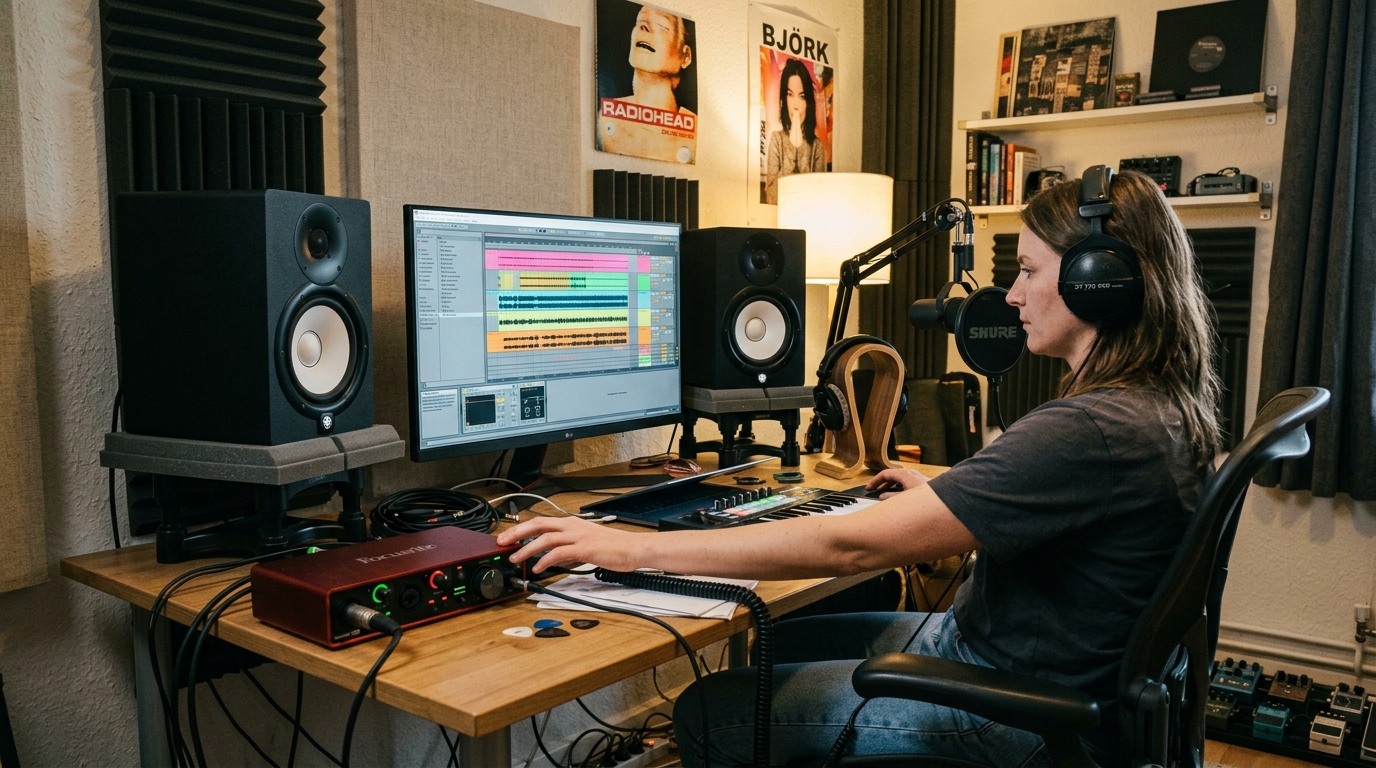

The Commercial Power of Modern Home Studios
A decade ago, recording commercial-grade music or high-end voiceovers required renting legendary commercial studios costing thousands of dollars per day. Today, Grammy-winning albums, global podcast chart-toppers, and blockbuster video game scores are mixed and produced inside treated bedroom and home studios.
The democratization of digital audio converters, digital audio workstations (DAWs), and precision algorithmic plugins has leveled the playing field.
However, having expensive gear does not guarantee good sound. The true secret to pro audio lies in acoustic physics, clean microphone technique, disciplined gain staging, and methodical signal processing.
Acoustics TruthA $200 microphone in a well-treated room will sound dramatically clearer and more professional than a $3,000 vintage tube microphone in an untreated, echoey bedroom.
Acoustic Treatment 101: Taming Reflections and Resonant Nodes
When sound waves leave your studio monitors or vocal cords, they bounce off drywall, glass windows, and hard floors, colliding back into the microphone diaphragm or your ears with phase cancellation. Treating your room is non-negotiable.
- Bass Traps in Vertical Corners: Low-frequency waves (below 250Hz) congregate in room corners. Thick dense fiberglass or rockwool traps absorb muddy boominess.
- First Reflection Points: Mount acoustic absorption panels on side walls directly between your listening position and studio monitors to eliminate flutter echo.
- Ceiling Cloud Absorption: Suspend acoustic absorption panels directly above your mix desk to absorb floor-to-ceiling vertical standing waves.
- Monitor Decoupling: Place studio monitors on dense isolation foam pads or heavy stands to stop mechanical vibrations from resonating through the desk.
Major Digital Audio Workstations (DAWs) Comparison
| DAW Software | Primary Genre / Workflow | Audio Editing Capabilities | MIDI & Sequencing | Native Plugins |
|---|---|---|---|---|
| Ableton Live 12 | Electronic, Hip-Hop, Live Performance | Very Strong (Warping Engine) | Industry Leading | World-Class Instruments |
| Logic Pro 11 | Commercial Pop, Songwriting, Film Scoring | Outstanding | Exceptional | Incredible Stock Bundle (Mac only) |
| Pro Tools Studio | Commercial Recording Studios, Post-Production | Unmatched Audio Editing Standard | Good | Industry Standard Utility |
| FL Studio 24 | Trap, Beatmaking, Urban Pop | Moderate | Fastest Piano Roll in Industry | Strong Synths & Generators |
| Studio One Pro | Acoustic Bands, Mixing, Mastering | Extremely Intuitive (ARA2 Integration) | Very Strong | Clean & Modern Stock Suite |
The Modern Professional Vocal Mixing Chain
A vocal must sit front and center in modern mixes: crisp, upfront, dynamic, and intelligible across smartphone speakers and car stereos alike. Process vocals using a disciplined serial chain.
Start with gentle pitch stabilization (Melodyne or Auto-Tune), followed by surgical subtractive EQ to carve out harsh room resonances (200-500Hz mud and 3-4kHz harshness). Apply serial compression (a fast FET compressor like an 1176 catching peaks by 2-3dB, followed by a smooth optical LA-2A smoothing overall dynamics). Add high-shelf air boost at 10kHz+, and send to parallel stereo delays and lush reverbs.
Mastering & Final Loudness Compliance
Before uploading to digital streaming platforms (Spotify, Apple Music, YouTube Music), master your tracks with reference to target integrated loudness standards (-14 LUFS to -10 LUFS) with a maximum True Peak ceiling of -1.0 dBTP to prevent inter-sample clipping during AAC/MP3 transcoding.